 OceanLog™
Train your way. We will adapt and support your work.
A session logbook for water sports coaches, made together with coaches like you.
Start free. Coaching on your own or running a school, we’ll set it up with you.
You built the training programme. We follow it.
Most software asks coaches to change how they work. We start from how you already do it.
Your levels, in your order
We use your own names. If level 1 is your top group, it stays level 1.
What you already measure
Your coaches keep assessing the way they do today. OceanLog records it as it is.
Quality of life, if you use it
We’re building in the Schalock & Verdugo domains for organisations that already work with them. An option, never required.
Available in 9 languages.
What you can do with it
- 1
Log a session in seconds. What you worked on, and how it went.
- 2
We add the conditions for you: sea, wind or pool, wherever you train.
- 3
See how each athlete is getting on, in plain words. They and their coach both see it in the app.
We never grade your athletes.
No leaderboards. Ever. Just how each person is getting on.
Easy for everyone.
Simple words, an easy-read mode and colours that work for colour-blind people.
Which one are you? One tap.
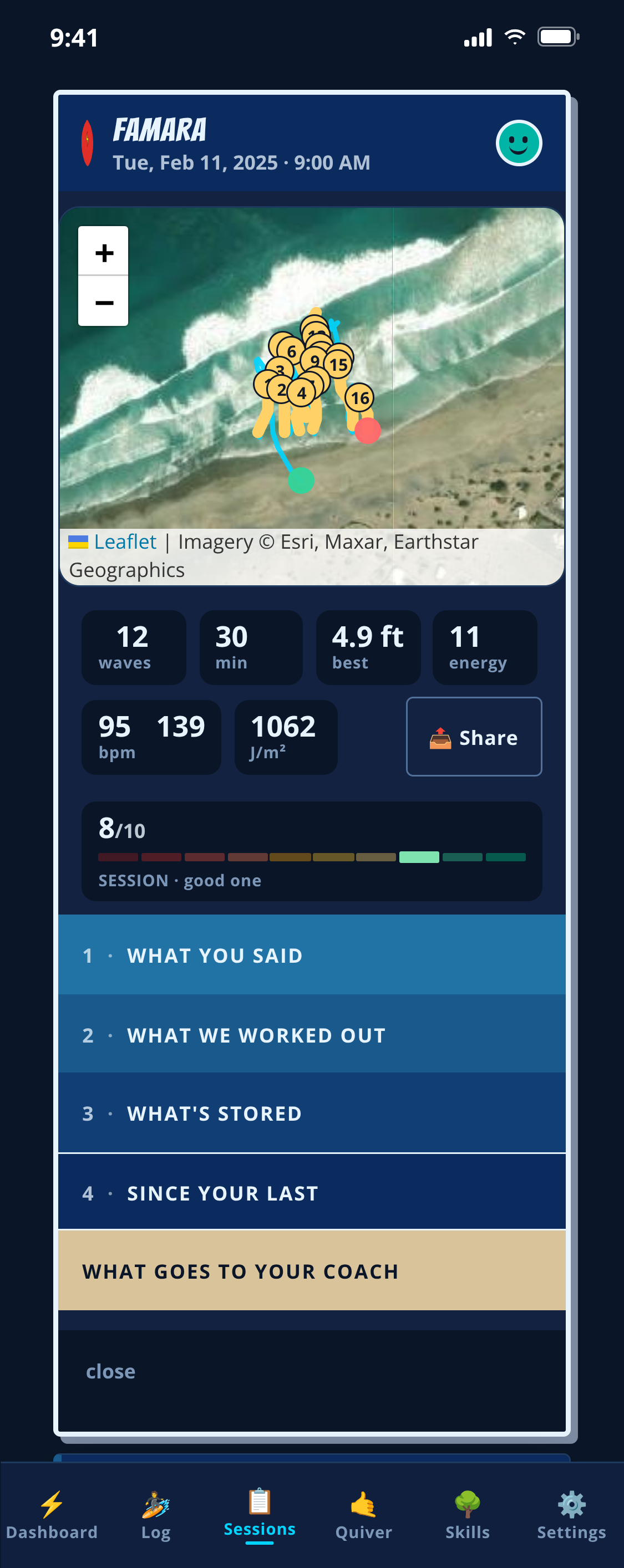
One week, one loop.
Tap + on any step to see it in the app.
-
1
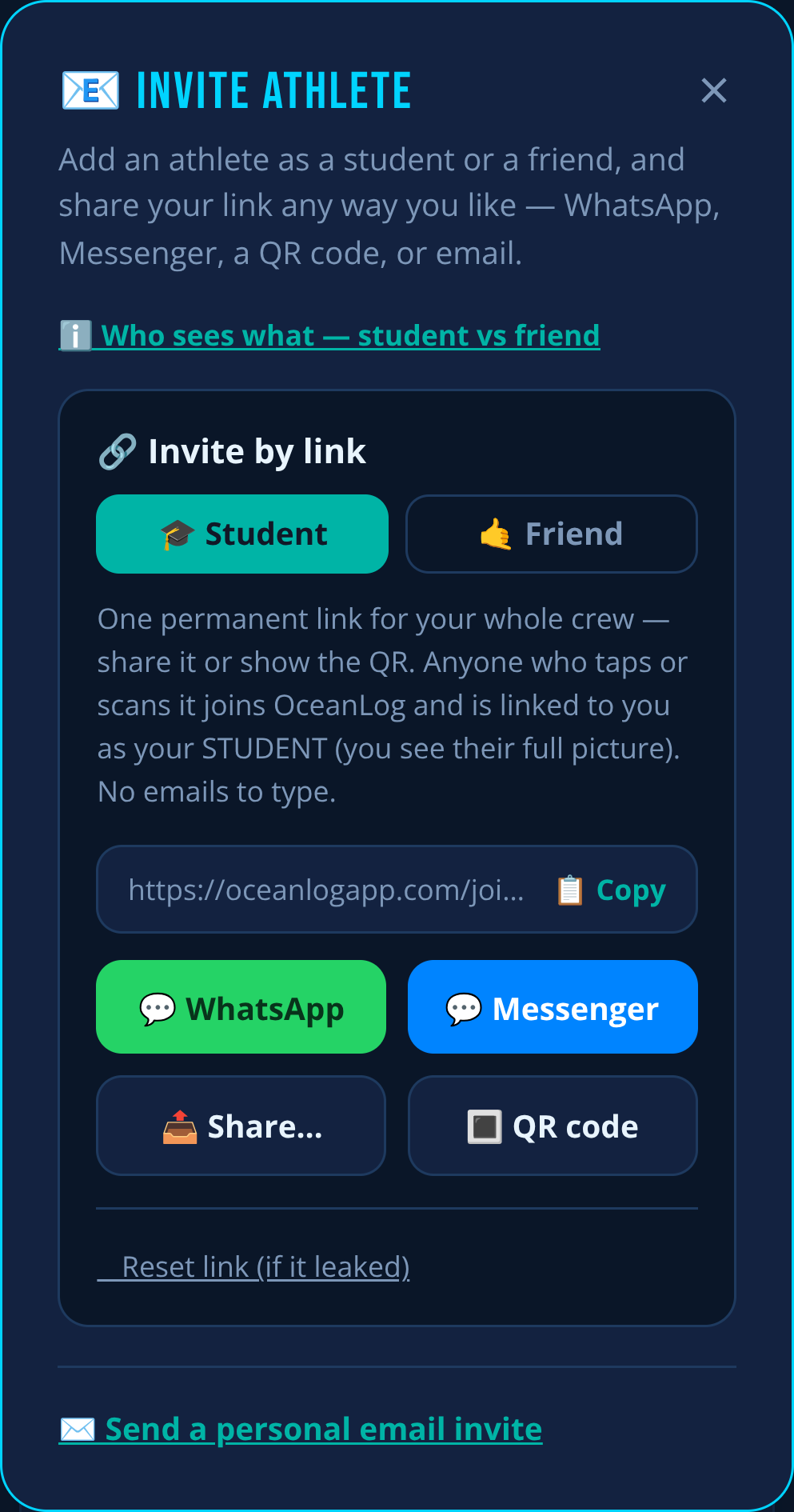
You invite an athlete
Full app, free on your seat.
-
2
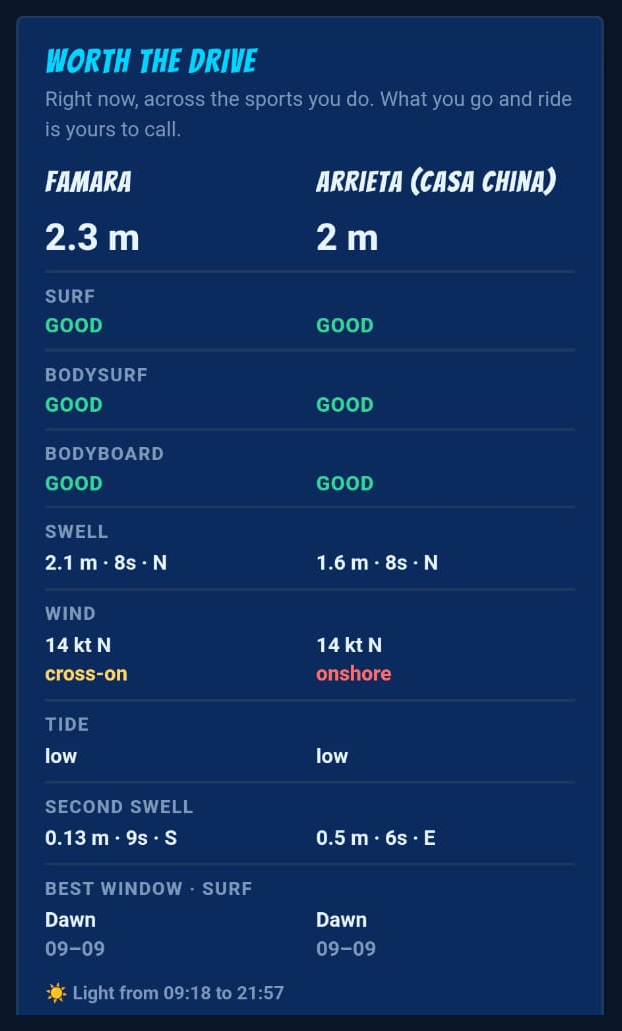
Worth the drive?
The forecast read against each student’s level and quiver.
-
3
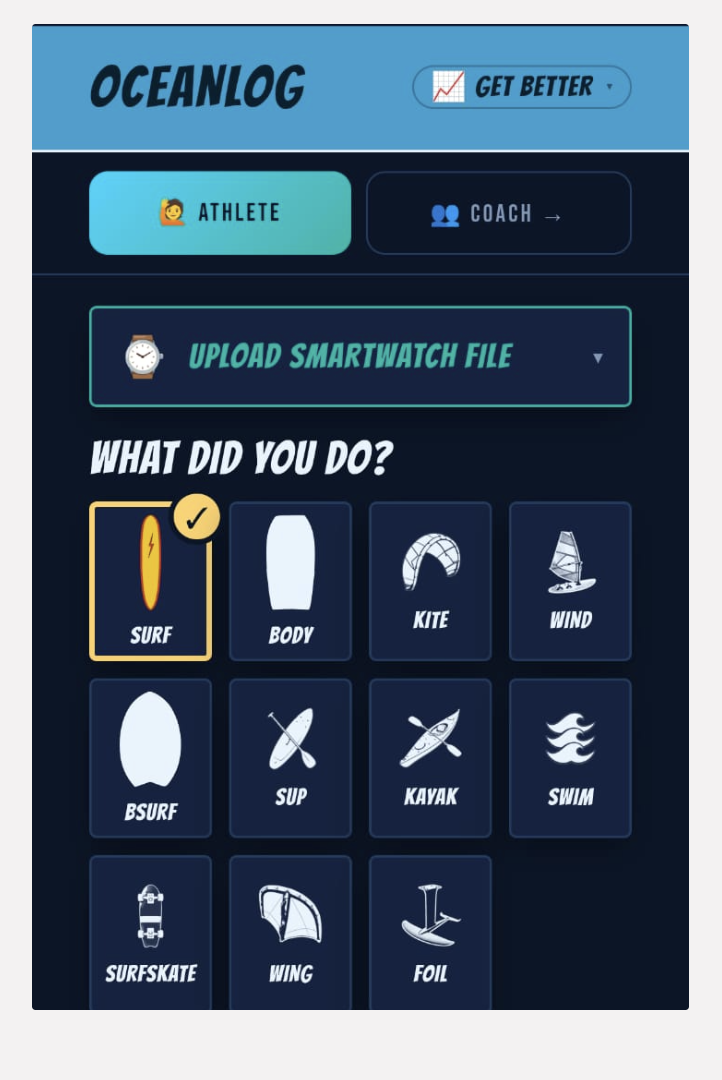
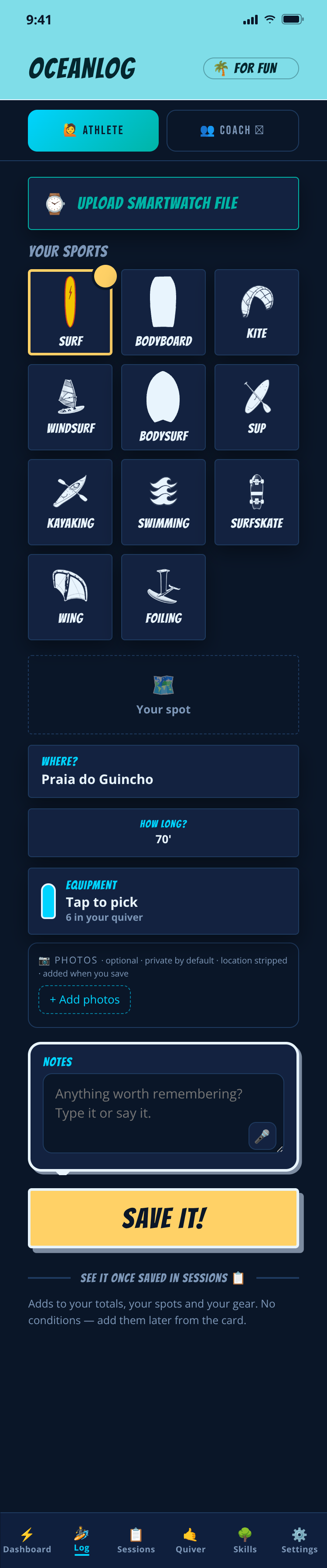
They log, in about a minute
Swell, wind, tide fill themselves in.
-
4
The session is read back
Plain language, flagged where data is thin.
-
5
In your voice
Your tone, your syllabus names.
-
6
You coach
The part nobody does better.
- 1You invite an athlete. Full app, free on your seat.
- 2Worth the drive? The forecast read against each student’s level and quiver.
- 3They log, in about a minute. Swell, wind, tide fill themselves in.
- 4The session is read back. Plain language, flagged where data is thin.
- 5In your voice. Your tone, your syllabus names.
- 6You coach. The part nobody does better.
↺ and back to 1
An app can describe a session. It cannot coach a person.
OceanLog surfaces. You decide.
It explains what it noticed, and why.
We never grade you. No leaderboards. Ever.
Everything a coach needs between two lessons.
The arrival briefing
A two-minute read: what they did since you last saw them, and where you can help.
Progression tree, per sport, per board
Tailored to the programme you teach. Some rows only a coach can fill.
One roster, every sport
Each sport you coach with its own fields, gear and language. Cross-training stops being invisible.
Gear against the day
Every board read against the conditions it met, explained for you and the student.
Numbers, when there are numbers
Watch files import themselves. No watch? It still works, and says when it estimated.
One seat. Your athletes log free.
2 minprep per athlete, down from twenty
25athletes on one coach seat
€0what your athletes pay
30 daysgrace when an athlete leaves you
+1 monthfor you, when one subscribes
“Good news, Marta just subscribed independently. You've earned a free month, and a coaching seat is open again.”The message you get at step four.
How the seat works
- 1You invite an athlete. Full access on your seat, free to them.
- 2They log; history builds. Every session joins their record, and yours.
- 3They leave coaching. Thirty days of grace. Nothing deleted unless they ask.
- 4They subscribe on their own. The seat frees, and a month is credited to you.
- 5You invite the next one. The roster stays fresh.
- 6Referrals. An athlete shares their best wave; a friend becomes step 1.
Time figures compare coaching a roster by hand with reading a prepared page, not a measured study.
Open what you need. Skip the rest.
Your syllabus, your languageWe adjust to your method, not the other way round.
The vocabulary is yours
Name your stages; reports use your words first, the athlete’s second.
Encouraging, direct, technical or plain
Set once per coach, override per athlete. Spanish, Catalan, German, Polish and more.
Mapped onto the skills tree
Re-label stages to match the levels you already award, alongside the frameworks working coaches use.
Your method stays yours
Never learned from, trained on or shared. It leaves with you.
Schools and clubs too
Groups through the same loop, per-athlete history, consent-gated pairing.
We claim no affiliation with, or endorsement by, any coaching programme or governing body.
What you see, and what you don’tConsent is the whole design.
Pairing is opt-in, and revocable
Nothing is visible to a coach who wasn’t invited. No back door.
Heart rate is off by default
Shared only by explicit choice. We never ask for a diagnosis. Anything about your body is yours, private by default.
Secret spots stay secret, from you too
Redacted everywhere, including the AI’s own input.
Your notes are yours
Private by default. Every acceptance recorded.
European data protection
GDPR and Spain’s LOPDGDD: consent logged, access, export and erase on request, no selling, no training.
Questions coaches askWatches, contradictions, exports, getting started.
Do my athletes need watches?
No. Watches only add numbers: .FIT, Apple Health, GPX or TCX.
Will it contradict me?
It isn’t built to. It describes, suggests, and defers the call to you.
An athlete already pays?
They keep their account and simply pair with you. Nothing lost.
Can I export what I’ve built?
Yes, exportable and deletable on request.
How do I start?
Email Xisco; he sets it up with you by hand. One athlete or twenty.
Our valuesEvery athlete. Every identity.
Pronouns
He, she, they or custom, LGBTIQ+ inclusive, in every language.
Communication
WhatsApp, email or phone. Each athlete chooses.
Tone
Adapted to age, level and preference, under your setting.
Accessibility
Simple words, an easy-read mode and colours that work for colour-blind people.
The planv1.0 on 1 Oct 2026.
29 Aug 2026 · Open beta
No invite, no card. First month after launch free too.
Now · More sports
nine sports live. Windsurf, wing and foiling in build.
1 Oct 2026 · v1.0
First paying subscribers.
2027 → Native apps
iOS and Android.
Join early, help shape it
Start using it now and tell us what works for you. Your feedback decides what we build next.
Ready now
- Swimming
- Surf
- SUP
- Kayak
- Rowing
- Bodyboard
- Bodysurf
- Surfskate
- Kitesurf
Coming soon: sailing.
Your data stays yours.
- Stored in the EU. We never sell it and never advertise.
- Each athlete chooses what their coach sees.
- AI reports are always marked as AI and stay in the app.
We never ask for a diagnosis. Anything about your body is yours, private by default.
Who’s behind it?
Two people who spend a lot of time in the water.
The founder
Xisco Morey. Airline captain, ground instructor and longboarder. He has logged every one of his own sessions for 9 years.
A coach’s eye
An ISA Level 2 surf coach helps us get it right.
Got 10 minutes?
Tell us about your typical coaching session. We’ll show you what it looks like in OceanLog.
Start free. Coaching on your own or running a school, we’ll set it up with you.
Or say hi to Xisco at xisco@oceanlogapp.com. He replies within 2 working days. School or club? → · Términos para Entrenadores